
Stop Your Sidewalks from Looking Like a Swamp
Why Your Charleston Brick Surfaces Need Attention Right Now
Brick power washing charleston homeowners rely on is one of the fastest ways to restore a grimy, green-stained exterior back to its original beauty. Here’s a quick look at what you need to know:
Quick answers for Charleston homeowners:
- Best method: Soft washing (low pressure + eco-friendly detergent) is safest for brick
- Frequency: At least once a year in Charleston’s humid climate; more often for high-traffic areas
- Average cost: $0.40–$1.00 per sq ft; full house exterior typically $275–$450
- Biggest threats: Mold, mildew, algae, and efflorescence caused by coastal humidity and salt air
- After cleaning: Apply a breathable sealant to protect mortar joints and repel moisture
Charleston’s Lowcountry climate is beautiful. But it is brutal on brick.
The combination of high humidity, salt air, and warm temperatures creates the perfect environment for mold, algae, and mildew to take hold — fast. If you’ve noticed your brick walkway, patio, or home exterior turning green, black, or just plain dingy, you’re not imagining it. As one local cleaning resource puts it plainly: “Here in the Charleston area, the mold and mildew are a real issue in terms of maintaining your home.”
For homeowners in neighborhoods like Mount Pleasant and Isle of Palms, that buildup isn’t just an eyesore. It can eat away at mortar joints, create slipping hazards, and quietly chip away at your property value — all while your neighbors’ homes stay sharp and clean.
The good news? Brick is incredibly durable when properly maintained. Regular cleaning stops the damage before it starts.
Why Brick Power Washing Charleston is Essential for Your Home
When we talk about brick power washing charleston, we aren’t just talking about making things look pretty for the next neighborhood oyster roast. We’re talking about preservation. In the Lowcountry, your home is constantly under siege from the elements.
The porous nature of clay brick makes it a literal sponge for moisture. When you add Charleston’s legendary humidity into the mix, you get a breeding ground for organic growth. If left untreated, this growth doesn’t just sit on the surface; it roots itself into the brick and mortar. Over time, this can lead to “spalling,” where the face of the brick begins to flake off, or the crumbling of the mortar joints that hold your walls together.
| Maintenance Level | Estimated Brick Lifespan | Aesthetic Condition | Risk of Structural Repair |
|---|---|---|---|
| Annual Professional Cleaning | 100+ Years | Like New / Pristine | Very Low |
| Occasional (Every 3-5 Years) | 70-80 Years | Visible Staining / Algae | Moderate |
| No Maintenance | 40-60 Years | “Swamp” Look / Erosion | High |
Beyond structural integrity, there is the health factor. Mold and mildew on your home’s exterior can contribute to poor air quality and exacerbate allergies for those living inside. Furthermore, a slippery, algae-covered sidewalk is a major liability. Professional pressure washing services remove these hazards, ensuring your walkways are safe for your family and guests.
Finally, consider the financial impact. According to the National Association of Realtors, pressure washing your home’s exterior can add $10,000 to $15,000 to its sale price. In high-end markets like Daniel Island or Sullivans Island, that return on investment is even more significant.
Choosing the Right Brick Power Washing Charleston Method
One of the most common mistakes we see is homeowners grabbing a high-powered pressure washer from a big-box store and going to town on their brickwork. This is a recipe for disaster.
Traditional power washing uses high-pressure water (sometimes up to 3,500 PSI) to blast away dirt. While this might be fine for a solid concrete slab, it can be devastating for brick. High pressure can strip the protective outer layer of the brick, leaving it even more porous and susceptible to future growth. Even worse, it can blast the mortar right out from between the bricks.
This is why we advocate for soft washing.
Soft washing is a professional cleaning method that uses low-pressure sprayers to apply a specialized, eco-friendly detergent solution. This solution does the heavy lifting by killing the mold, algae, and mildew at the root. After the solution has had time to work its magic, we rinse it away with a gentle stream of water.
The differences between these methods are backed by scientific research on power washing vs pressure washing, which notes that while “power washing” often implies hot water for breaking down grease, “soft washing” is the gold standard for delicate residential surfaces like brick and stucco.
The Impact of Charleston Humidity on Masonry
If you live in Downtown Charleston or West Ashley, you know that the “Lowcountry Green” isn’t just a paint color—it’s a living organism on your walls.
The humidity here causes several unique issues for masonry:
- Algae and Moss Buildup: These organisms thrive in the shade and moisture provided by our coastal environment.
- Efflorescence: This is the white, powdery substance you often see on brick. It occurs when water dissolves salts within the brick and carries them to the surface as it evaporates.
- Moisture Retention: Because our air is so thick with water, bricks rarely have a chance to dry out completely, which accelerates the decay of older lime-based mortars common in historic Charleston homes.
To combat these issues, we recommend a proactive approach. Our residential services are designed to handle these local nuances, ensuring your home remains a sanctuary rather than a swamp.
Step-by-Step Guide to Cleaning Your Brick Surfaces
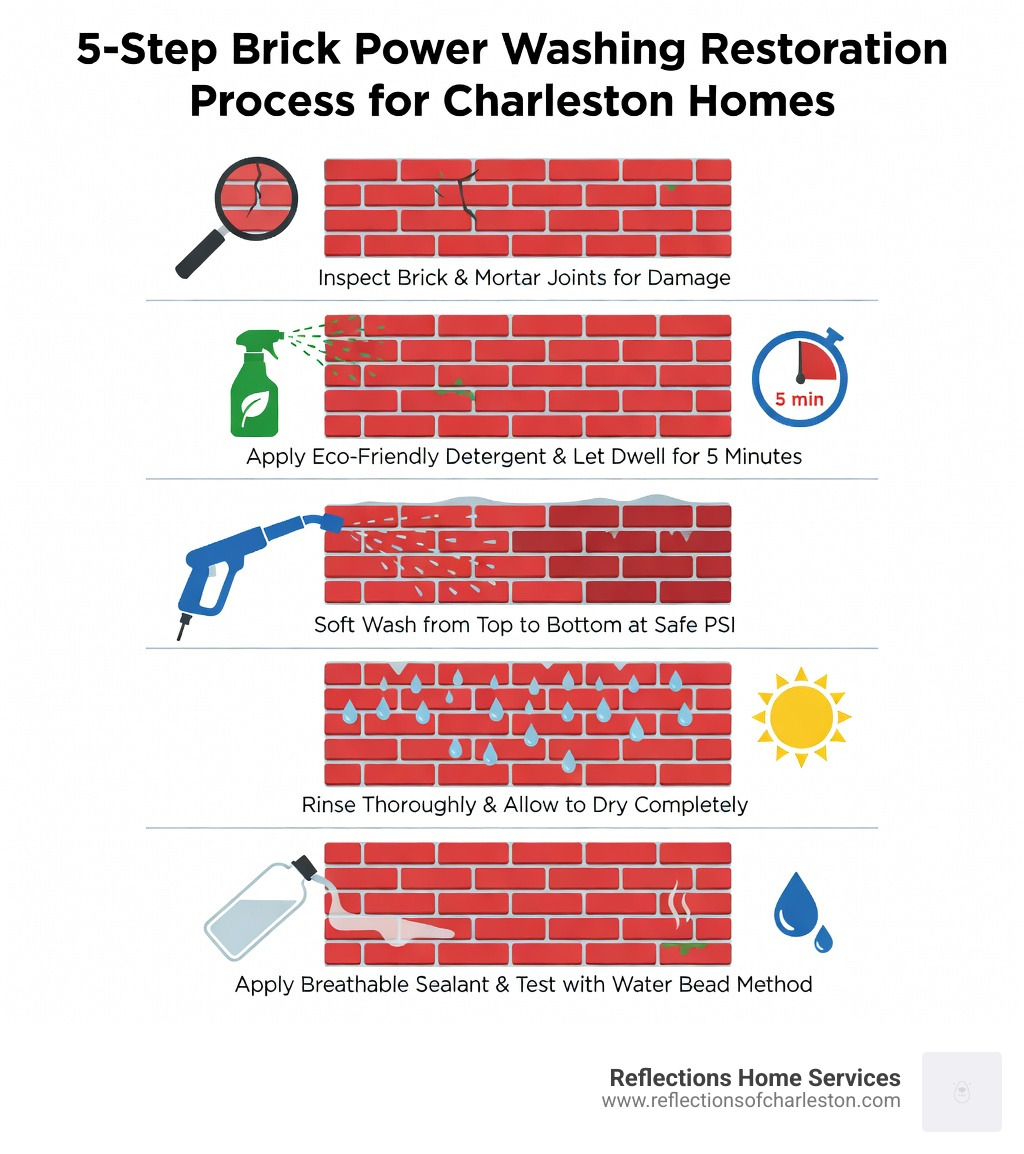
While we always recommend professional intervention for the best results, understanding the process helps you know what to look for when hiring a team. Here is how we approach a standard brick power washing charleston project.
- Preparation and Inspection: Before any water hits the brick, we inspect the area for loose mortar or cracked bricks. We also ensure that all windows and doors are sealed and that nearby plants are protected.
- Detergent Application: We apply a professional-grade, eco-friendly detergent. This isn’t just soap; it’s a surfactant-rich solution designed to break the bond between the grime and the brick.
- Dwell Time: This is the most important step. We let the solution “dwell” on the surface for about five to ten minutes. This allows the cleaners to penetrate the pores and kill the biological growth.
- The Gentle Rinse: Using a wide-angle nozzle and low pressure, we rinse the brick from the top down. This prevents dirty water from streaking already-cleaned sections.
- Joint Protection: We pay special attention to the joints. If the mortar is soft, we adjust our distance and pressure to ensure we aren’t causing any erosion.
Our home services team follows this rigorous process to ensure every nook and cranny of your masonry is restored without the risk of damage.
Professional Tips for Brick Power Washing Charleston
To get that “concierge-level” finish, there are a few trade secrets we use that make all the difference:
- The Water Bead Test: Once the brick is dry, sprinkle a little water on it. If the water soaks in immediately, your brick is thirsty and unprotected. If it beads up, your sealant is doing its job.
- Use Breathable Sealants: Never use a “film-forming” sealer on brick. Brick needs to breathe. We use silane/siloxane-based sealants that penetrate the surface to repel water while still allowing water vapor to escape from the inside.
- Nozzle Selection: A “0-degree” nozzle is essentially a laser beam that will carve your name into a brick. We typically use 25-degree or 40-degree tips for a wider, gentler fan of water.
- Gutter Maintenance: Believe it or not, your bricks stay cleaner when your gutters work. Overflowing gutters dump water directly onto your siding, leading to rapid algae growth. We often recommend checking your gutter protection systems during an exterior clean.
- Dry Before You Seal: You must wait at least 24 to 48 hours after washing before applying a sealant. Sealing moisture into the brick is a recipe for disaster.
Understanding the Cost of Professional Brick Cleaning
One of the most frequent questions we get is: “How much is this going to cost me?”
In the Charleston market, prices can vary based on the complexity of the job, but we can provide some general benchmarks based on local industry data.
Average Charleston Power Washing Estimates:
- House Exterior (1,500-2,000 sq ft): $275 – $450
- Standard 2-Car Driveway: $100 – $200
- Brick Patio or Deck: $150 – $300
- Per Square Foot Rate: $0.40 – $1.00
Several factors influence the final quote:
- Soil Level: A patio that hasn’t been touched in a decade will require more detergent and dwell time than one cleaned last year.
- Accessibility: Two-story homes or brick walls tucked behind dense Lowcountry landscaping require more labor and specialized equipment.
- Water Access: If we have to bring our own water or use long hose runs, it can impact the price.
- Insurance and Licensing: At Reflections Home Services, we carry comprehensive liability insurance. While “a guy with a truck” might be cheaper, he likely doesn’t have the coverage to protect your home if he blasts a hole through your mortar.
Frequently Asked Questions about Brick Cleaning
How often should I wash my brick surfaces in Charleston?
For most homes in the Lowcountry, an annual cleaning is the gold standard. However, if your brick patio is under a heavy canopy of oak trees or near a pool, you might need a touch-up every six months. A good rule of thumb: the more often something touches the surface (feet, paws, or falling leaves), the more often it needs to be washed.
Is power washing safe for historic Charleston brick?
Yes, but only if done by professionals using soft washing techniques. Historic bricks, especially those made before the 20th century, are much softer than modern bricks. They often use lime-based mortar which can be easily washed away by high pressure. We use specialized, low-PSI methods to preserve the integrity of historic masonry in Downtown Charleston.
What is the difference between power washing and soft washing?
The primary difference is pressure and temperature. Power washing uses high-pressure, often heated water to blast away grime. Soft washing uses low pressure (similar to a garden hose) and relies on chemical surfactants to kill biological growth. For brick, soft washing is almost always the better, safer choice.
Conclusion
Your home’s brickwork is a major investment and a defining feature of your property’s curb appeal. Don’t let the Charleston humidity turn your beautiful estate into a swampy eyesore.
At Reflections Home Services, we specialize in providing tailored, concierge-style care for the most beautiful homes in Charleston, Mount Pleasant, and the surrounding islands. Our team understands the unique challenges of the Lowcountry climate and uses the safest, most effective methods to restore your masonry to its original glory.
From the initial inspection to the final water bead test, we guarantee a level of detail that “standard” pressure washers simply can’t match. We don’t just clean; we preserve.
Ready to see the difference professional pressure washing can make? Contact us today for a consultation and let us help your home reflect the beauty of the Lowcountry.